
Imagine buying a Ferrari, locking it in first gear, and forcing it to drive behind a tractor for eight hours a day, five days a week.
You wouldn't blame the Ferrari for sputtering, overheating, or trying to swerve off the road. You would blame the driver for fundamentally misunderstanding the machine.
Yet, every single morning, millions of parents do exactly this to their most precious assets. We take exceptionally bright, gifted children and place them in traditional classrooms designed for the absolute average. We force them to sit still, wait for the rest of the class to catch up, and endure hours of repetitive instruction on concepts they grasped in the first ten minutes.
When they inevitably zone out, act up, or lose their spark, the system slaps a label on them: "distracted," "unmotivated," or "disruptive."
Let us be brutally honest. Your gifted child isn't distracted. They are bored out of their mind. And the traditional education system isn't failing them by accident — it is punishing their intelligence by design.
The Myth of the "Self-Taught" Genius
There is a dangerous, pervasive myth in education: that truly gifted children will figure it out on their own. That raw talent is self-sustaining. That if a child is smart enough, they don't need a different environment — they'll simply rise above it.
A landmark 50-year longitudinal study by Vanderbilt University researchers tracked thousands of intellectually precocious children from adolescence into adulthood. The conclusion was unequivocal: gifted children do not automatically thrive on their own. Without adequate intellectual stimulation, many plateau — or worse, regress.
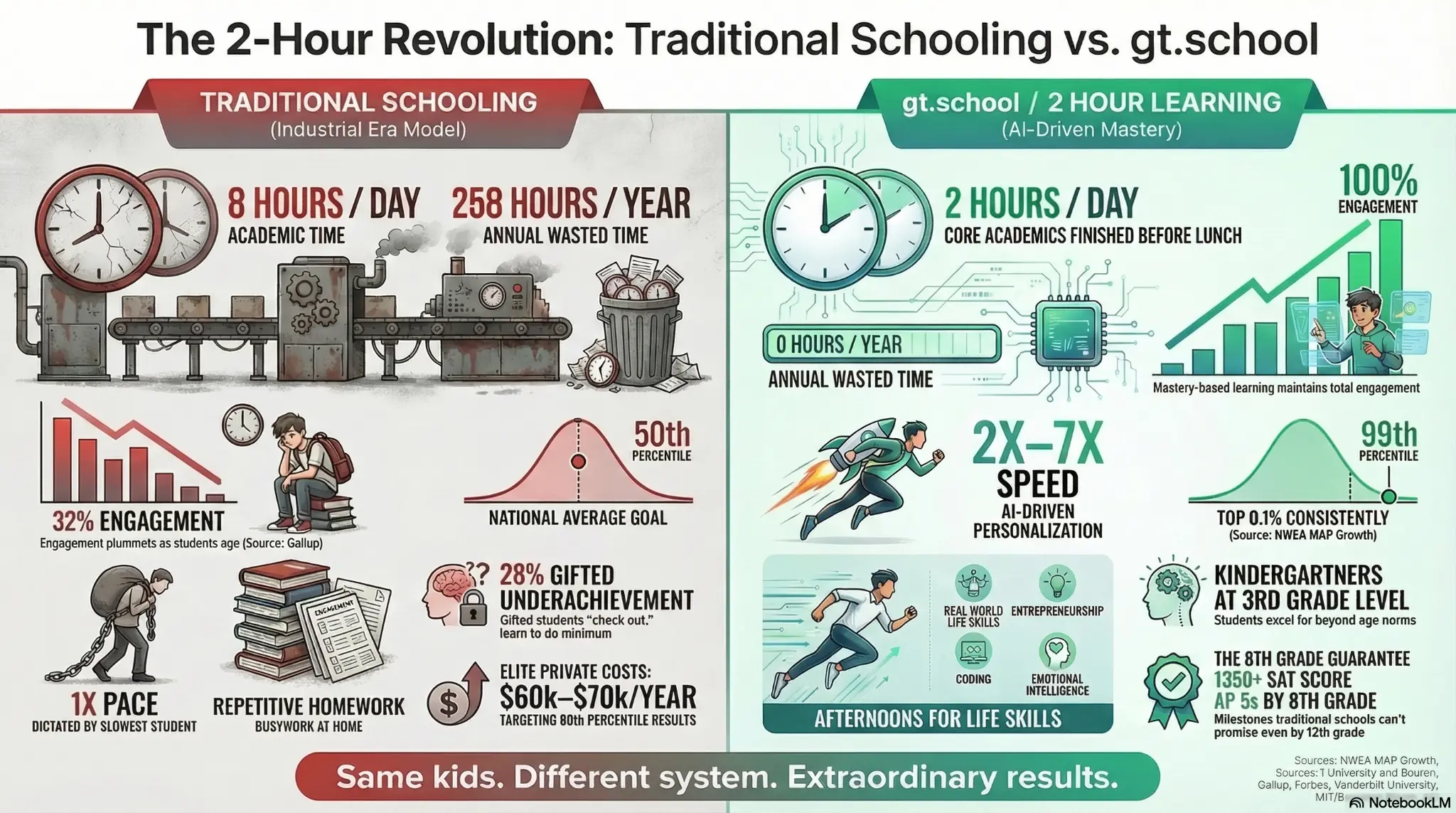
The academic literature paints an even grimmer picture. A systematic review published in Heliyon found that up to 28% of gifted students experience severe underachievement during their compulsory education. They learn to do the bare minimum. They develop poor work habits because nothing ever challenges them. Some learn to hide their abilities entirely, just to fit in.
Meanwhile, the standard interventions offered by traditional schools — an extra worksheet here, a "gifted pull-out program" once a week there — amount to giving our Ferrari a racing stripe and telling it to get back in line.
It is a cosmetic fix for a structural failure.
The 2-Hour Paradigm Shift
If the system is broken, the question becomes whether we keep patching it or start building something fundamentally different. A growing number of educators and researchers are betting on the latter — and one of the most radical experiments is an approach called 2 Hour Learning.
The premise is deceptively simple: instead of forcing gifted minds to conform to an industrial-era bell schedule, use artificial intelligence to adapt the schedule to the mind. Advanced AI tutors and mastery-based learning apps replace the one-size-fits-all lecture. Students using this method don't spend eight hours a day on core academics.
According to the data, students using this method master the full curriculum in just
That claim deserves scrutiny. So I looked at the data.
The concept draws on a well-established principle in educational research. In 1984, Benjamin Bloom published his famous "2 Sigma Problem," demonstrating that one-on-one tutoring produces learning outcomes two standard deviations above traditional classroom instruction. The challenge was always scale — you can't hire a personal tutor for every child. AI, proponents argue, finally solves that equation.
Whether you find this compelling or too good to be true, the standardized test results are difficult to dismiss. Schools using the 2 Hour Learning method report that students starting in Kindergarten are on track to complete high school academics with 5s on AP exams and a 1350+ SAT score by the 8th grade — a claim they back with a written guarantee.
According to NWEA MAP Growth data, 5th graders using the 2 Hour Learning method (RIT 230) already outperform the national 11th-grade average (RIT 226). By 11th grade, these students score at what NWEA classifies as college-level mathematics.
What Happens to the Other 6 Hours?
The immediate question any skeptical parent will ask is: "If they finish academics in two hours, what do they do with the rest of the day?"
This may be the most interesting part of the model. The goal of extreme academic efficiency isn't simply to finish early — it's to reclaim time. Time is arguably the most valuable currency in a child's development, and traditional schools spend it recklessly.
With core academics completed before lunch, students in this model spend their afternoons on what most schools claim to value but never have time for: deep dives into academic passions, entrepreneurial projects, financial literacy, physical fitness, creative arts, and the kind of social-emotional development that actually prepares young people for adult life.
The shift is philosophical as much as practical: from producing test-takers to developing capable, well-rounded human beings.
The Cost of Doing Nothing
None of this is to say that AI-driven education is without questions. Concerns about screen time, socialization, and the long-term effects of algorithmic learning are legitimate and deserve rigorous study.
But here is what we know for certain: the current system is already failing gifted children at scale. The data on engagement collapse, underachievement, and wasted instructional time isn't speculative — it's documented by Harvard, Gallup, and Vanderbilt.
The question for parents isn't whether the new models are perfect. It's whether the status quo — a system built over a century ago to produce compliant factory workers — deserves the blind trust we continue to place in it.
Your child's intelligence is not a burden to be managed. It is a force to be matched with an environment worthy of it. Perhaps it is time to take the Ferrari off the tractor path and see what it can really do.
The tools exist. The data is mounting. The only question left is how long we're willing to wait.
Meet the School Behind the Method
gt.school is the private online school that developed and implements the 2 Hour Learning method. Visit their website and see for yourself the results they've achieved — and how they're transforming education for gifted children around the world.
Get to Know gt.school →The school behind the 2 Hour Learning method

Sources
- Vanderbilt University — Study of Mathematically Precocious Youth (SMPY), 50-year longitudinal study
- Raoof, K. (2024). "Unpacking the underachievement of gifted students." Heliyon, ScienceDirect
- Gallup Student Poll — Student Engagement Data (2024)
- Kraft, M.A. (2024). "Instructional Time in U.S. Public Schools." Harvard/Brown University
- NWEA MAP Growth — Schools using the 2 Hour Learning method (2025-2026)
- Bloom, B.S. (1984). "The 2 Sigma Problem." Educational Researcher, 13(6), 4-16